Foundation Osiliana scientifically researches archaeological and historical sites and artefacts of prehistorical and medieval Saaremaa. In addition to Saaremaa, Muhu and other surrounding smaller islands (e.g., Vilsandi, Abruka) are researched.
For research, a Database of Artefacts of Saaremaa will be created that will give an overview of the archaeological artefacts, different types of finds, local and imported material culture.
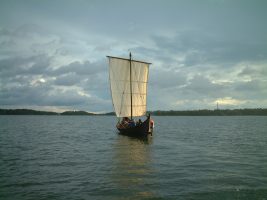
Tornimägi was until 19th century known in Estonian as Hill-Fort (“Linnamägi”), because of its peculiar landscape. However, archaeological excavations have shown that there was a Viking-Age harbor site!
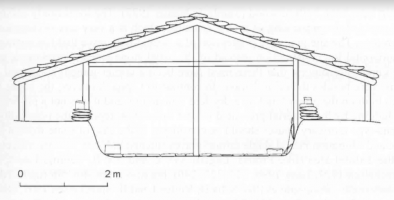
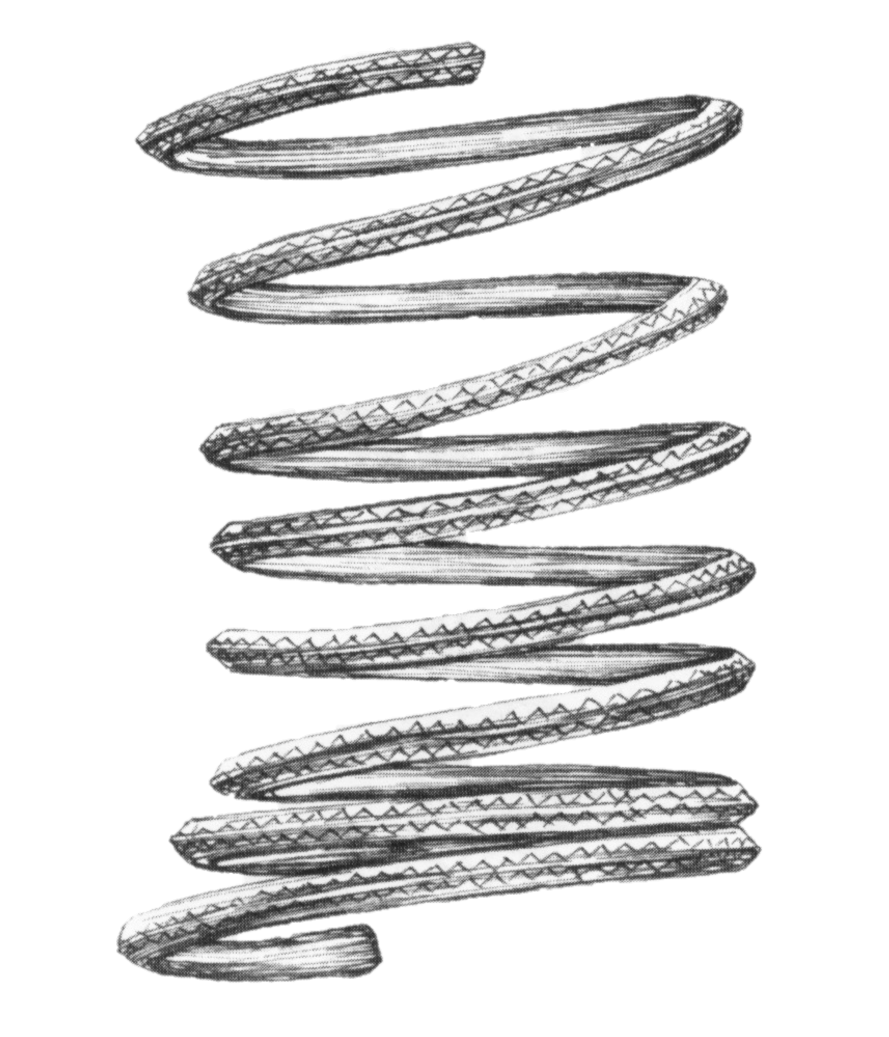
Lepna mortuary house was a cult building, which was used for collective sacred rituals for the deceased. Besides its particular function, it also stands out with its rich silver artefacts from the 5th-6th centuries of the Great Migration that is otherwise a rather poor era.
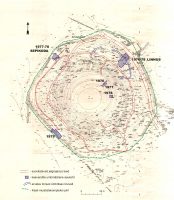
Kaali lake and the surrounding cultural landscape have traces of human activity already from the Bronze Age. There are many mythical stories about the meteor crater, but what do we know by the archaeological excavations?
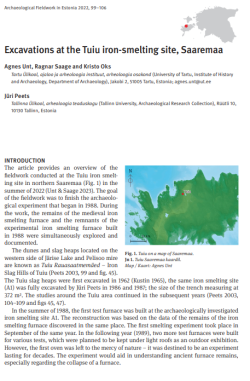
The article Excavations at the Tuiu iron-smelting site, Saaremaa gives an in-depth overview of an iron-smelting site situated in North Saaremaa that was first used already in the 8th century but saw its most intense use during the period from 12th to 14th centuries.
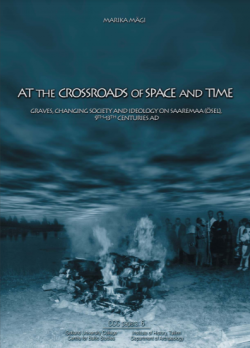
Monography At the Crossroads of Space and Time. Graves, Changing Society and Ideology on Saaremaa (Ösel), 9th–13th centuries AD dives into the centuries of the end of prehistorical and early medieval period of Saaremaa and Muhu. It is mainly based on the burials and the artefacts, which are analyzed in the international context with the rest of the archaeological material and written sources.
President Alar Karis awards the Order of the White Star, Fourth Class, to Osiliana’s director and Doctor of Archaeology Marika Mägi.
“Estonia expresses its recognition to leading scholars who have made a significant contribution to the development of a smart, knowledge-based society and to the advancement of education.”
Warm congratulations to all those who have received this distinction! Long live Estonian science, and the scientists and supporters who make it possible!
As we very soon welcome the new year, we are delighted to announce that Foundation Osiliana will continue researching the early history of Saaremaa with the support of Kristjan Rahu!
Five years ago, a group of enthusiasts led by philanthropist and entrepreneur Kristjan Rahu and Marika Mägi, Doctor of Archaeology at Tallinn University, established Foundation Osiliana with the aim of conducting scientific research into the early history of Saaremaa. We are now pleased to announce that Kristjan Rahu has decided to support the foundation’s activities for the next five years with a total of €750,000.
Thanks to donations from Kristjan Rahu and several other history enthusiasts, numerous thorough archaeological excavations have been carried out on Saaremaa over the past five years using state-of-the-art technology, and several geophysical and laboratory studies have been conducted. The research has significantly expanded our knowledge of Estonia’s early history. The Valjala and Pöide hill forts have been thoroughly studied, and additional research has been conducted on the Kaarma and Muhu hill forts. Special attention has been paid to the burial sites of the first Christian islanders, which date back to the 13th century. Several analyses have been carried out on those buried there, including ancient DNA testing.
Several scientific articles have been published on the results of the research. In cooperation with the Saaremaa Museum, an exhibition on medieval islanders was curated, and in 2026, a book on medieval Estonia will be published in cooperation with the Estonian History Museum and the University of Tartu. Audio guides in Estonian and English have been created for Valjala hill fort, and a 3D model of Valjala is being developed, which will allow visitors to explore the different parts of the hill fort.
In addition, an Estonian- and English-language web platform www.osiliana.eu/en has been developed, which brings together databases of archaeological finds, research, and translations of documents from Saaremaa, and regularly publishes overviews of the foundation’s activities and research results. Members of the Osiliana team have presented the history of Saaremaa and Estonia at international conferences in Norway, Sweden, Denmark, Iceland, Spain, and the Czech Republic.
Many thanks to all our supporters and have a wonderful new year!
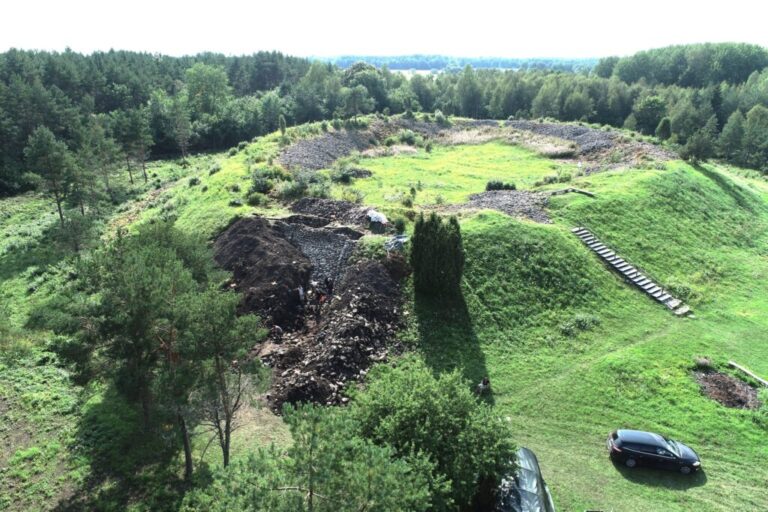
Excavations at Valjala hill fort in 2023.
Congratulations to Kristjan Rahu on the Tullio Ilomets Heritage Conservation Award presented by the Estonian Heritage Society!
Over its five years of operation, the Foundation Osiliana has developed into a remarkable and exceptional phenomenon in both the Estonian and the international humanities landscape. Its initiator and principal supporter, Kristjan Rahu, has through his intellectual and material contributions created conditions comparable to the impact of the great philanthropists of history — we can only imagine how much less colours the world would have, for example, without the contributions of the Medici. Thanks to Kristjan Rahu’s consistent support, Osiliana has been able to research the history of Saaremaa, and Estonian history more broadly, at the highest international level.
Since its establishment in 2020, Osiliana has engaged systematically in the study of Saaremaa’s archaeological heritage, currently focusing primarily on the Late Iron Age and the Early Middle Ages. Research has concentrated on hillforts and burial sites associated with this period, and their interpretation has made extensive use of modern natural-science analyses. In just five years, numerous archaeological, historical, geoarchaeological, and laboratory studies have been carried out, and modern technology has been acquired that enables fieldwork and data collection at a significantly higher level than before. The research is led by the experienced archaeologist Marika Mägi, and the foundation has deliberately involved young historians and archaeologists in its activities, thereby contributing to the emergence of a new generation of researchers.
One of the foundations of Osiliana’s success has been the understanding that technical resources and funding for analyses alone are not sufficient. Equally important is investment in people aka the researchers themselves, whose work quality and continuity depend on stable and dignified income. For many years, research into the early history of Saaremaa and the Estonian islands more broadly relied largely on enthusiasm, as financial resources were extremely limited. Osiliana’s activities have significantly changed this situation, and the foundation has developed into a small but effective research center that has earned recognition both in Estonia and internationally. We have presented Saaremaa’s and Estonia’s history at conferences in Iceland, Sweden, Norway, Denmark, Spain, and elsewhere.
The results of this research have also been visible to the wider public. Saaremaa’s historical sites have become more accessible and better presented, both in the digital environment and on site, offering new knowledge to local residents and visitors to the island alike. Even more important, however, has been a scholarly shift in the interpretation of Estonia’s earlier history, especially concerning the 13th and 14th centuries, where the role of local communities is now seen as far more active than before. In the case of Saaremaa, this new interpretation has been largely supported by Osiliana’s research results, which would not have been possible without Kristjan Rahu’s financial and moral support.
In the current complex geopolitical situation, the significance of such research is particularly important. Studying, interpreting, and presenting one’s own history at the international level is not merely an academic pursuit, but an essential part of cultural self-awareness and continuity. Osiliana’s work is a clear example of how purposeful philanthropy and professional scholarship can together create a lasting and far-reaching impact.
We have launched our audio-guides in English (and Estonian) for Valjala hillfort!
Finally, we can reveal to you a project we have been working on for some time now and the first fruits of it are in front of you.
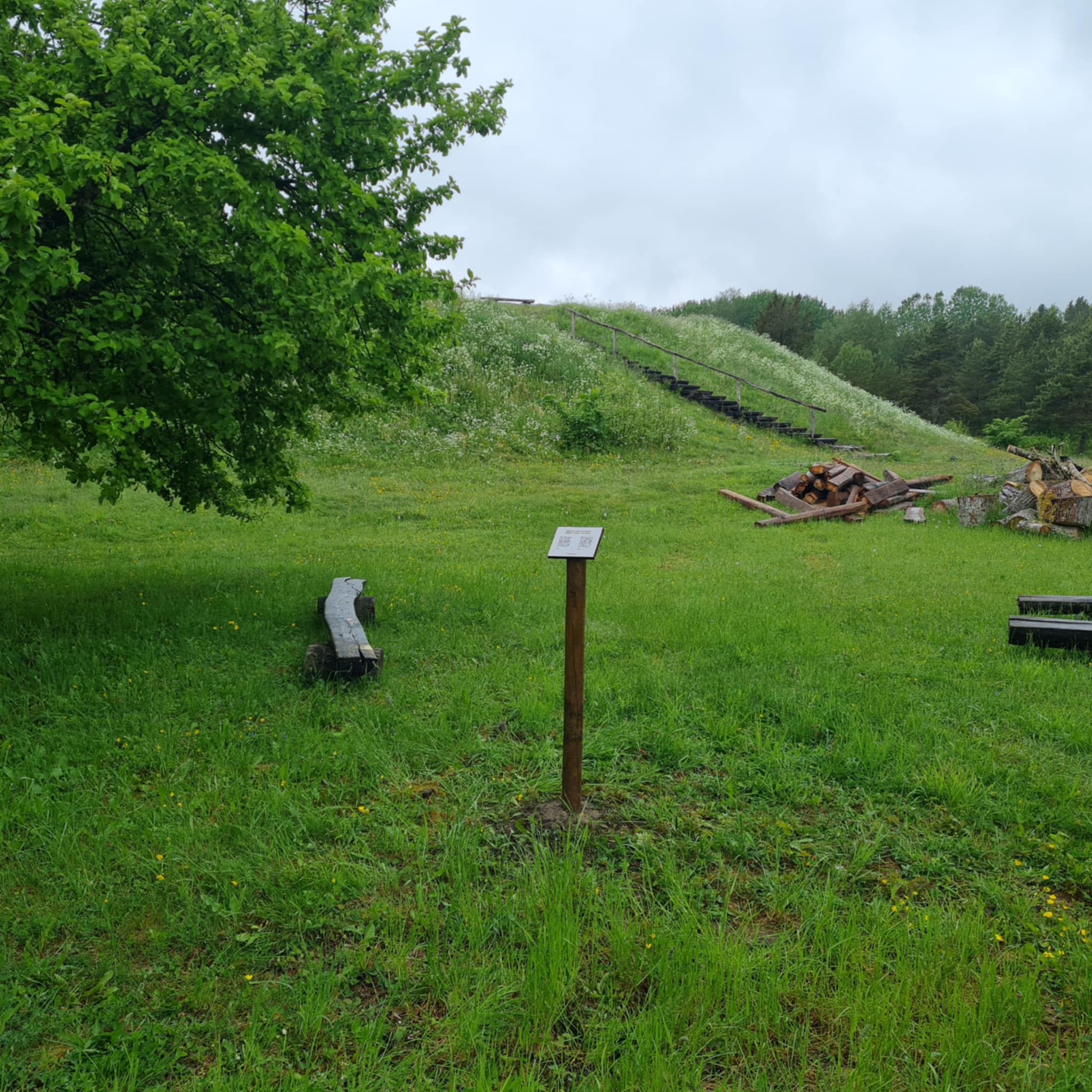
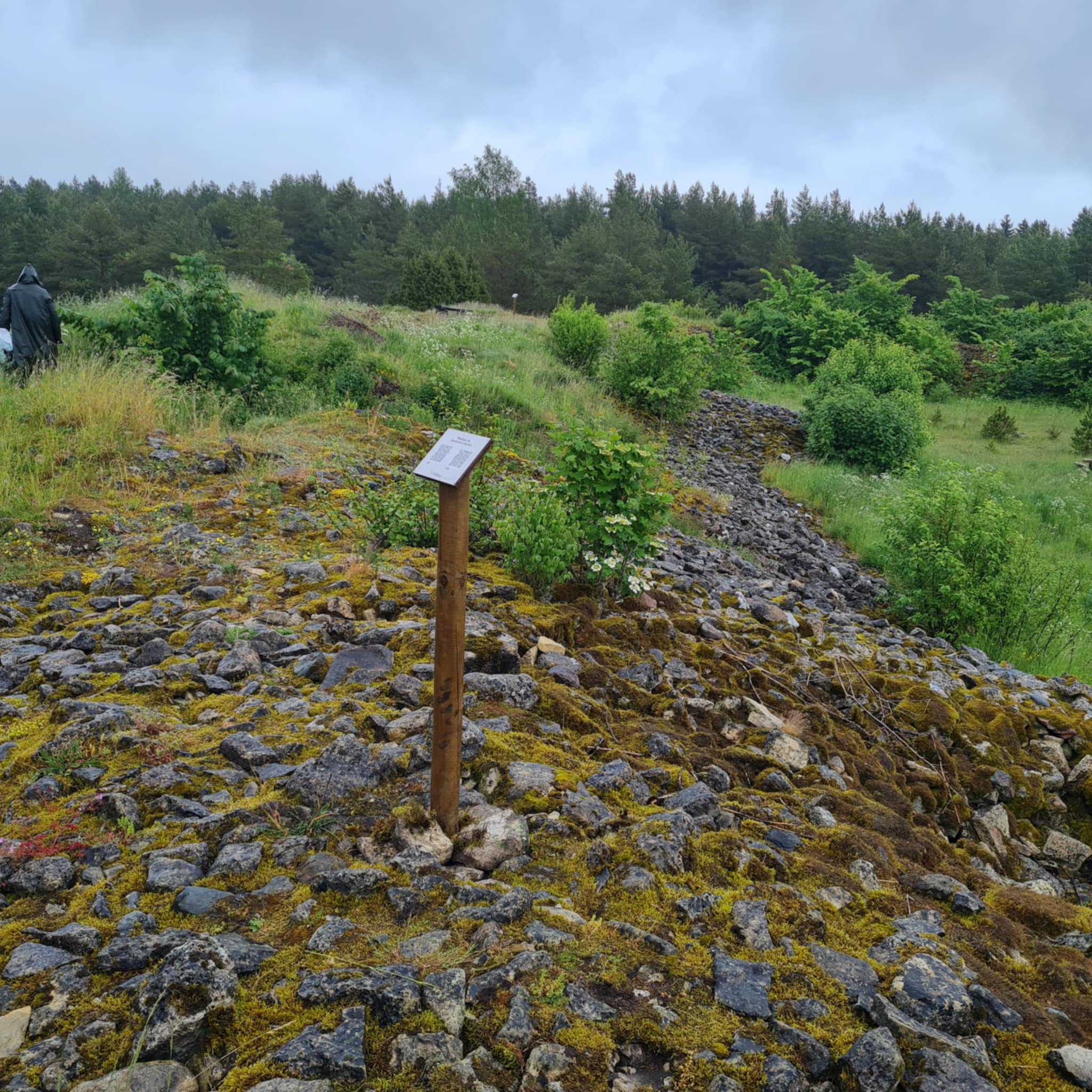
There are four audio guides in Valjala hillfort available freely to anyone to use: one telling the story of the town of Valjala, another of the hillfort itself, one about the courtyard of the hillfort in its heyday and what took place in there, and one about the ramparts of the hillfort.
The audio-guides can be listened to via QR codes attached to the posts in four different locations – in locations that offer the best view according to the theme.
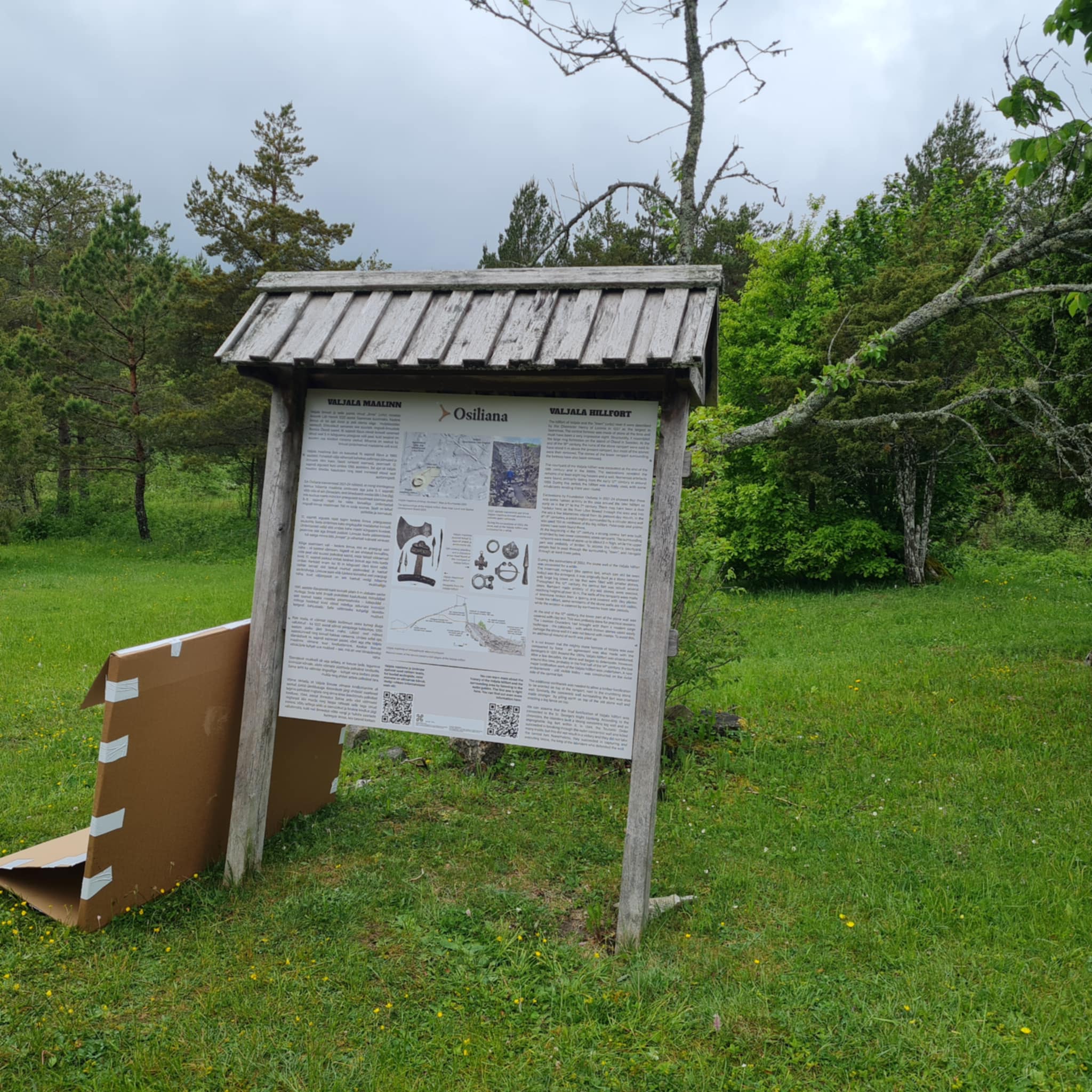
In addition, we replaced the old information poster with a new one.
Here’s also a little sneak-peak in the form of an audio guide to the town of Valjala:
All the archaeological artefacts that are either gained through the operation of SA Osiliana or given to SA Osiliana, will be conservated and organized by the expenditure of SA Osiliana, and artefacts will be transferred to the Saaremaa Museum.
Collected information and written reports are also transmitted by SA Osiliana to the National Heritage Board. In addition to the National Heritage Board, the reports will also be transmitted to the archive of Tallinn University’s archaeological research collection and the archive of Saaremaa Museum.
The artefacts registered by the SA Osiliana will be transferred to the National Heritage Board for heritage protection.